
Bench Warrants in Clarendon County
In Clarendon County, a bench warrant is a court order that may follow a missed appearance, bond violation, contempt, or failure to follow an order. The statewide SCCA523 form is titled “Bench Warrant” and describes a failure to appear after bond was set. It directs an officer to take the person into custody and bring the person before the court.
Family Court can have support or family-order contempt matters; Magistrate and municipal courts handle summary cases; General Sessions handles higher-level criminal cases. An unpaid fine or missed payment schedule does not automatically use the Texas term “capias pro fine.” Ask the issuing court how its docket labels the event.
Clarendon Bench Warrants Cross Four Courts
A bench warrant can come from General Sessions, Family Court, Clarendon Magistrate Court, or a municipal court. The record often stays with that court even when an officer from the Sheriff’s Office or a town agency serves it. For a support question, call Family Court at 803-435-4210. For a traffic or misdemeanor case, identify the Magistrate or city court before asking about recall.
This split is why a countywide online search cannot settle every question. Clarendon has no public sheriff list located, and the court index may not expose a separate bench-warrant status.
How a Clarendon County Bench Warrant Is Issued
The judge who controls the case decides whether to issue a bench warrant after a court event. The SCCA523 form records the missed date, underlying charge, case number, judge, court, and a service return. It directs a lawful officer to take the person into custody and bring the person before court within 24 hours. That statewide form is a model, not a live Clarendon record.
There is no public statewide warrant roster in South Carolina. A court case entry may help identify the case, but it does not guarantee that an active warrant or service return appears online. The issuing court confirms what remains open.
Clarendon SCCA523 Shows the Court Path
The blank SCCA523 form shows a county caption, case number, defendant name, missed-court date, prior bond, underlying charge, judge signature, court address, and officer return. It also carries place-of-service and county or municipality certification fields. Those labels help a person understand a copy received from court, but personal fields should never be copied into a public example.
The official court-forms index also lists SCCA413 and SCCA413A. Neither form is a local search tool or a public warrant roster.
The image is the official forms index, not a completed form.
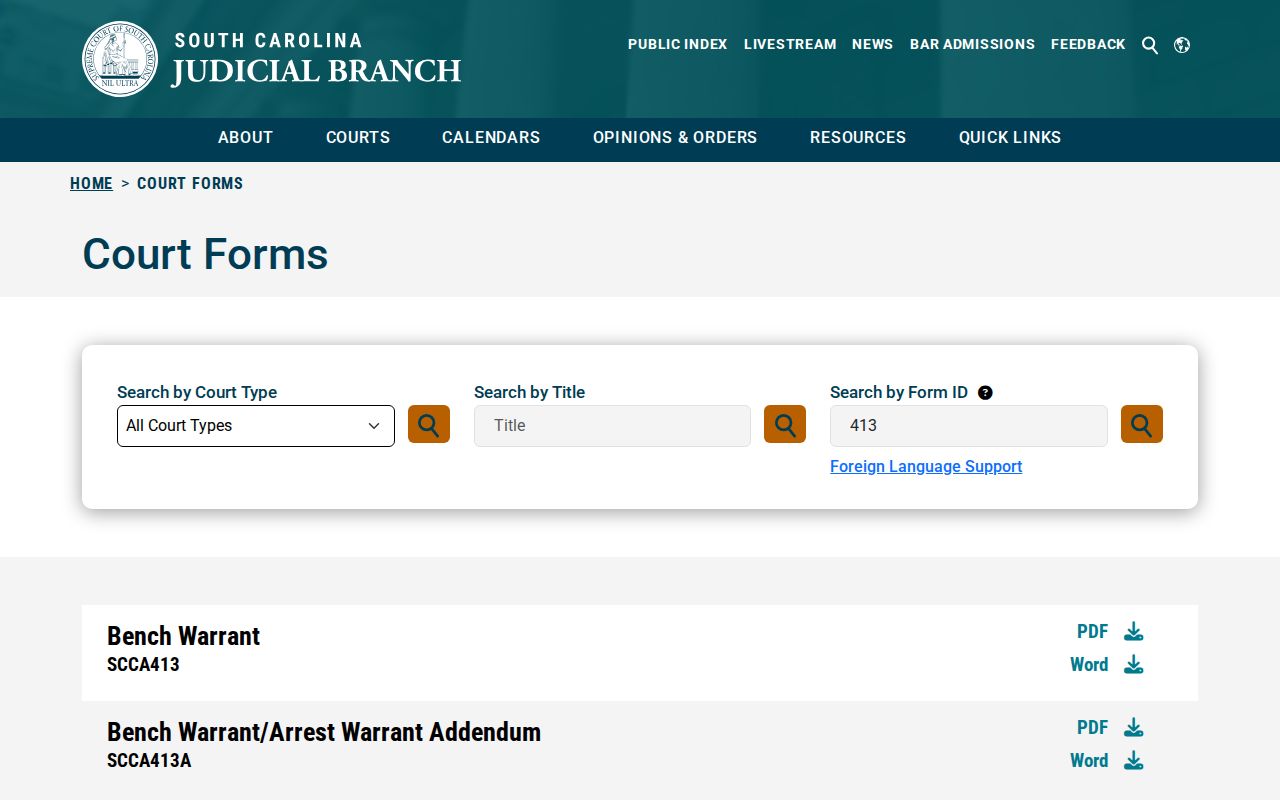
Ask the court for the correct record and do not infer current status from a blank form.
Bench Warrant vs Arrest Warrant
A bench warrant enforces a court date, bond condition, or order in an existing case. An arrest warrant begins with probable cause for an alleged offense. Both can lead to custody, but the judge and next step differ. The companion page on Clarendon arrest warrants explains the officer request and Rule 3 record handoff.
| Feature | Bench Warrant | Arrest Warrant |
|---|---|---|
| Trigger | Missed date, bond issue, contempt, or order. | Probable cause for an alleged offense. |
| Who issues | Judge in the court that owns the case. | Magistrate or municipal judge at the initial stage. |
| Underlying case | Existing case or court obligation. | Criminal charge process. |
| Next step | Ask court about appearance or recall. | Ask court or counsel about service and bond. |
Clarendon Detention Sets a Different Bond Rule
The county Detention Center states that bench-warrant or contempt custody from Family, Magistrate, Municipal, and General Sessions Court does not receive an ordinary bail or bond hearing. The person stays in custody until summoned before the court that controls the case. This local rule matters more than a general assumption that every arrest can be resolved by paying bond at the jail.
Applicable bond hearings are posted for 8:30 a.m. and 5:30 p.m. daily or as the duty magistrate directs. The facility is cash-free. Ask the court how any payment or release paperwork works before traveling.
How to Resolve a Bench Warrant
Start by finding the court and asking what the judge requires. Clarendon posts no general warrant-clearing appointment, amnesty event, recall form, or walk-in protocol. A lawyer may ask about a scheduled appearance or motion before someone travels to the courthouse or detention center.
- Use a notice or case number to identify the issuing court and case type.
- Call the court and ask whether the judge allows a motion, reset, payment, or lawyer-arranged appearance.
- Ask where to report and whether a bond hearing applies before traveling.
- Keep the signed recall, release, or new-date document and check that the online case updates.
Caution: Do not assume a ticket payment or empty online search recalls a bench warrant; ask the issuing court for written instructions.
Clarendon Manning and Summerton Contacts
Manning Municipal Court is at 36 West Boyce Street and can be reached at 803-433-0050. Summerton Municipal Court is listed at 10 Main Street with phone 803-485-2525. These courts handle their own ordinance and qualifying traffic cases. A police-service agreement or change does not transfer a court’s authority to the Sheriff.
For the county summary court, call Magistrate Court at 803-435-2670 or 803-435-8925. The Clerk of Court at 803-435-4443 handles General Sessions case records. Ask which court number belongs on the record before asking for a recall.
Clarendon Family Warrants Need Family Court
Family Court handles child-support, family, and juvenile matters through the Clerk’s family division. Call 803-435-4210 about the correct office. Child-support payment printouts are available Thursdays from 1 to 3 p.m., but that is a printout schedule, not a warrant-clearance appointment.
Do not assume a Family Court matter appears on the Public Index or Sheriff’s site. Ask the family division what information is public, what hearing is set, and whether the person must appear.
Which Clarendon County Court Issued It
A bench warrant remains with the court that set the underlying case. The Sheriff may serve it or route a question, but only the issuing court can order a recall or new date. General Sessions cases go through the Clerk; summary cases stay with Magistrate or Municipal Court; Family Court is a separate contact.
Use the Clarendon County warrant search steps to identify the likely court, then call that office. A search result does not substitute for the judge’s instruction.