
How to Check for a Warrant in Paxville
Begin with any notice, citation, or court paper connected to the question. Record the exact agency and court name, the case or citation number, the date, and the person's full name. No public Paxville warrant search or dedicated town warrant phone line was found, so use the local contact route to identify the custodian before treating an online result as complete.
- Use the office named on the paper or ask Paxville's local officials where that type of record is kept.
- Give the records custodian the case number and date; use full name and date of birth to distinguish similar names.
- Ask which court controls the case and how to confirm its present status or next hearing.
- For a county matter, use Clarendon County's court records and confirm with the issuing office.
- Get the court's instructions before paying, appearing, or assuming a case has closed.
No Paxville Warrant Portal Was Located
The public research did not find a town-operated warrant roster, searchable municipal docket, online payment page for warrants, or a dedicated surrender channel for Paxville. That is a limit in the available public-facing information, not proof that a person has no pending process or that a town record cannot be requested.
Because there is no town lookup screen to interpret, make the first call a routing question: which office keeps this kind of record, and which court can confirm its status? Ask for the official name and a direct number, then keep the date and name of the person who answered for your own follow-up.
The Paxville Police Department and Municipal Court
Research did not locate a separate Paxville Police Department warrant page or a public town-court contact listing. The available sources therefore do not support naming a local warrant desk, clerk, payment vendor, or walk-in procedure. Use the court or agency shown on the actual notice rather than relying on an assumed town department.
If no paper is available, contact the municipality through its current official public contact route and ask which public body has responsibility for the specific type of case. Confirm whether the answer concerns law-enforcement service, court records, or a citation balance; those functions may be held by different offices.
Use the Document to Find Paxville's Issuing Office
The research did not identify a current town warrant calendar, amnesty event, or public list with local case numbers. Instead of guessing at a form or program, start from an original ticket, summons, bond paper, or court notice. These documents ordinarily provide the court or agency name and a reference number that lets the custodian distinguish one case from another.
If the notice is old or incomplete, ask the office to search by the event date and the person's identifying information. Ask whether the file has moved, whether a hearing was reset, and whether a separate warrant record exists. A verbal search result should be followed by the court's instructions for obtaining written confirmation.
Types of Paxville Warrants
A question associated with Paxville could concern a traffic ticket, a town-rule citation, a missed court date, or a criminal investigation. The available profile does not confirm a separate municipal court, so the categories below describe possible case routes rather than asserting that Paxville maintains each docket locally. Use the court named on the notice.
| Warrant Type | How It Arises | Who Issues It |
|---|---|---|
| Traffic citation | Unresolved ticket or missed appearance | Court named on the citation |
| Town-rule matter | Notice alleging a local ordinance violation | Confirm the assigned court with the issuing office |
| Failure to appear | Missed a scheduled hearing after notice | Court that set the hearing |
| Arrest warrant | Judicial process connected to a criminal case | Issuing court identified in the record |
Paxville's Small Population Does Not Identify the Court
The 2020 Census counted 232 residents in Paxville. That local population figure helps distinguish the town in regional profiles, but it does not say how a particular citation or criminal case was filed. Venue follows the law and the issuing document, not a person's address or the size of the municipality.
When calling, describe the event rather than asking only whether a name appears on a list. A traffic citation, an ordinance notice, and an arrest-related case may be maintained by different offices. Give the date and document number where possible and ask the official to tell you which court is responsible.
What a Paxville Warrant Record Shows
No Paxville-specific record layout or local warrant-number pattern was found. If an official record is produced, compare its identifying fields with the original paper before acting. The court name, docket number, charge, and status matter together; a familiar name or an amount by itself is not a reliable match.
| Warrant / Cause Number | Match it to the number on the notice; no Paxville numbering format is published. |
|---|---|
| Subject Name | Check the complete name and other identifiers available to the custodian. |
| Charge / Offense | Compare the description with the ticket, summons, or charging paper. |
| Issuing Court | Use the court named in the record, not an assumed town venue. |
| Bond / Fine Amount | Ask what the amount covers and whether it is current. |
| Status | Request confirmation of active, recalled, satisfied, or otherwise closed status. |
A Court Directory Is a Lead, Not a Paxville Docket
The state courthouse search provides location and contact information for listed courts and public offices. It can help a resident identify a nearby records counter, but it is not a live roster of warrants and does not establish that a particular Paxville citation appears in a county or municipal database.
Use the directory to identify the official office that may be able to route a question, then provide the record identifiers and ask which court actually holds the file. If a search does not return a Paxville label, request a current referral instead of concluding that no proceeding exists.
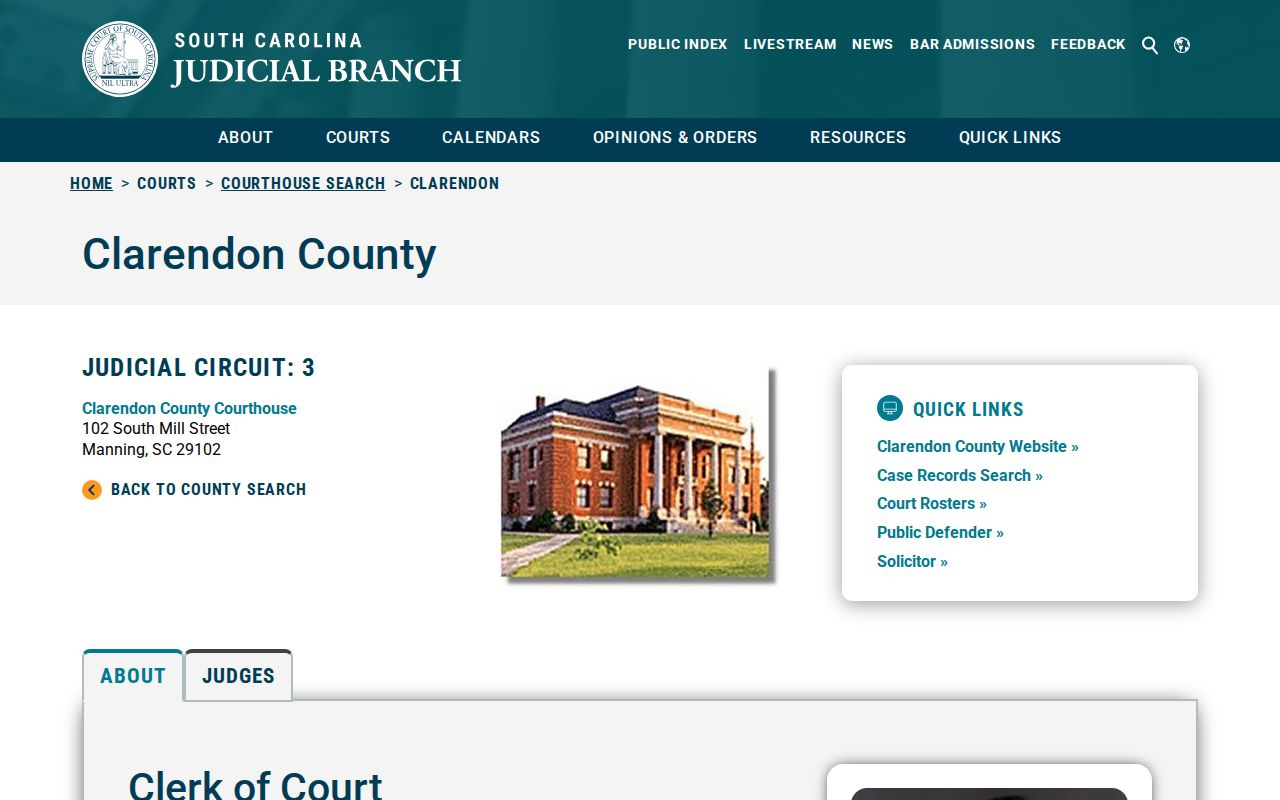
Confirm that a directory listing is the custodian for the specific record before relying on it.
Where Paxville Warrants Fit With Clarendon County
The county plan describes the Sheriff's service area as including unincorporated Clarendon County and Paxville; that service coverage does not confirm a town warrant list or change the identity of the issuing court. South Carolina has no single public statewide warrant roster. For county-level search steps and office contacts, use the Clarendon County records overview and county warrant search, then verify the specific file with its issuing court.
Warrant flow: Paxville-area notice › confirmed records custodian › Clarendon County Sheriff when service is involved
Confirm the Paxville Office Before Requesting Copies
A focused request is more useful than a broad demand for every record tied to a place or person. State the date range, case or citation number, court shown on the notice, and the type of record requested. Ask first whether the office is the custodian and whether another court keeps the underlying case file.
For a public record, request the available non-exempt portion and ask how the office handles inspection, copies, and any search or redaction charge. Keep a copy of the request and the response. That paper trail is useful if a later hearing or new notice changes the question.
A Paxville Traffic Search Needs the Ticket Details
The South Carolina traffic search can be queried with a citation number, a driver's license and state, or a name with date of birth. It can help locate some traffic matters, including some municipal traffic cases, but it is not a complete warrant index and does not show every town ordinance or criminal file.
Use it only when the question concerns a traffic citation, then ask the court named on the ticket to confirm any warrant or appearance status. A blank search does not cancel the original citation.
South Carolina traffic ticket searchPublic Access to Paxville Warrant Records
Public-record access is controlled by the actual record and the custodian's legal duties. Some law-enforcement material may be exempt, and juvenile records carry separate confidentiality protections. A search result or public-record response should not be used to publish another person's private information or to make an employment, housing, or credit decision.
Key Rules:
South Carolina Freedom of Information Act, § 30-4-30 - provides access to public records within the rules set by law.
South Carolina Code § 30-4-40 - identifies information that may be withheld under statutory exemptions.
South Carolina Children's Code, Title 63, Chapter 19 - protects certain juvenile court and related records from public disclosure.